Translating Features Into Benefits Without the Fluff
6 min read
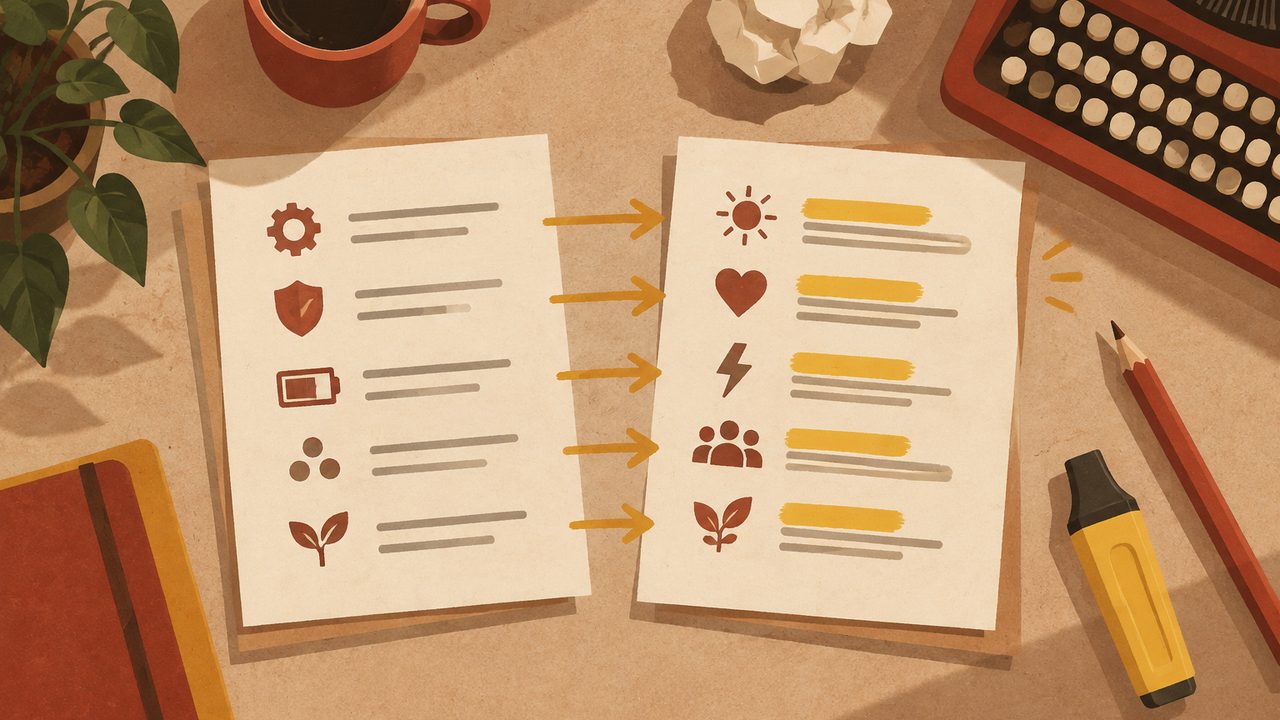
Most weak benefit copy starts with a useful fact and ends with an empty promise. “Automatic invoice reminders” becomes “Take your business to the next level.” The writer has moved away from technical language, but also away from anything a buyer can picture. What happens next week if they buy? That question remains unanswered.
The job is not to replace every feature with an emotional claim. It is to connect what the product does with a change the customer values, then give them a reason to believe it. Good benefit copy makes that connection quickly. It can still include specifications, limits and practical details. Often, those details are what make the benefit convincing.
Separate the feature, the mechanism and the benefit
A feature is something the product has or does. A mechanism explains how it works in the customer's situation. A benefit is the useful consequence. Keeping these separate during drafting prevents the leap from a modest capability to an extravagant promise.
Take an appointment system with automatic text reminders:
- Feature: scheduled SMS reminders.
- Mechanism: clients receive a message before their appointment without staff sending it individually.
- Benefit: staff have fewer reminder messages to send by hand.
“Reduce missed appointments” is another possible benefit, but it needs more care. A reminder may help, yet the result depends on delivery, timing, the client and the appointment type. Without evidence, lead with the direct operational benefit rather than implying a guaranteed commercial result.
A credible benefit is a useful consequence you can explain, not a bigger promise you hope nobody questions.
Start with a customer task, not a list of adjectives
Before rewriting a feature, name the task it supports. “Busy professionals” is too broad to guide a sentence. “A freelance designer chasing three overdue invoices on Friday afternoon” gives you something to work with.
Look for that detail in sales calls, support tickets, reviews and onboarding questions. Collect the customer's description of the problem, including what they currently do to work around it. A workaround often reveals value more clearly than a general wish: copying figures between spreadsheets, carrying a spare charger or emailing five people for approval.
Use three drafting questions
- What is the customer trying to do? Describe an action, such as sending a quote or packing a school lunch.
- What gets in the way? Identify the delay, uncertainty, effort or risk.
- What changes because of this feature? State the closest useful outcome the product reliably supports.
For a lunchbox with removable compartments, the task might be packing different foods without them mixing. “Designed for happier families” is a stretch. “Keep crackers separate from fruit, then lift out the compartments for washing” explains two practical reasons to care, provided the product actually does both.
Build a short, believable chain
A useful drafting formula is: feature → practical change → customer payoff. Write all three parts first, then edit for the space available. You do not need to force the whole chain into every headline.
The examples below are illustrative. Each assumes the product works as described; none needs an invented performance statistic to sound useful.
| Feature | Fluffy translation | Specific benefit copy |
|---|---|---|
| Saved quote templates | Supercharge your productivity | Start each quote with your standard terms and services already in place. |
| Removable blender blade | Enjoy effortless living | Remove the blade to clean underneath it instead of reaching into the jug. |
| Version history | Create with total confidence | Restore an earlier draft if today's edits take the work in the wrong direction. |
| Recorded workshop lessons | Learn on your terms | Replay the demonstration while you practise, pausing at each step. |
| Stock alerts at a chosen threshold | Never miss a sale again | Get an alert when stock reaches your chosen level, so you can review reordering. |
Notice that the stronger versions do not all promise time savings. Some offer easier cleaning, reversibility or better timing. Forcing every feature into “save time and money” makes different products sound interchangeable.
Stop before the chain becomes speculative
Saved templates can remove repeated setup work. That might help someone send quotes sooner. It does not automatically mean they will win more clients or double their revenue. The further you travel from the feature, the more evidence and qualification you need.
Use the nearest meaningful payoff as your default. Add a larger outcome only when customer research or reliable product data supports the connection.
Make specificity do the work of hype
Words such as “seamless”, “powerful” and “intuitive” ask the reader to accept your judgement. Specific details let them make their own. Instead of “seamless setup”, describe the setup: “Import your contacts from a CSV file, then map the columns before saving.” That may be less glamorous, but it answers a buying question.
Numbers can sharpen a benefit, but false precision weakens trust. If a tool replaces a six-step process with two steps, explain which steps disappear. If you claim it saves 30 minutes a day, you need a defensible basis for that figure, including the task measured and the conditions.
- With evidence: state the measured result and its relevant scope.
- Without evidence: describe the work removed or the capability added.
- With variable results: explain what the result depends on.
For example, “Generate a monthly report from connected sales data” is useful without a time claim. “Finish reporting in seconds” may overlook account setup, data checks and commentary. Do not hide those jobs behind a stopwatch.
Keep the features buyers need to compare
“Sell benefits, not features” is an editing prompt, not a rule to delete specifications. Buyers may need dimensions, file formats, battery capacity, access limits or material composition to decide whether something fits their requirements.
Place the benefit beside the relevant detail. A product page might say: “Fits beneath a desk: 42 cm high with the lid closed.” But check the full use case: if opening the lid needs another 20 cm, that clearance belongs in the specification too.
Match the emphasis to the placement
In an advert, lead with one problem and one payoff. On a product page, explain the mechanism and provide supporting detail. In a comparison table, retain the exact features buyers need to assess alternatives. The same message can travel across all three, but it should not carry the same amount of information everywhere.
Edit and test for understanding
Review each claim before publishing. Ask whether a reader could picture the change, whether the product directly supports it and whether you have implied an outcome outside your control. Underline vague phrases; replace them with an action or delete them.
Then show the copy to a few people who resemble the intended customer. Ask: “What does this do?”, “When would you use it?” and “What would you still need to know?” Do not ask only whether they like it. Pleasant wording can still leave the offer unclear.
When testing live copy, choose a measure close to the decision: qualified enquiries, trial activation or purchases, rather than clicks alone. A bigger promise may attract attention while bringing in people the product cannot help.
Conclusion: make the payoff easy to see
Start with a real task, explain what changes and stop where your evidence stops. Keep the specifications that matter. The strongest benefit copy does not make an ordinary feature sound miraculous; it makes its usefulness obvious to the right buyer.
Marketing Notes is reader-supported and may earn a commission from links to tools we mention. This article is general information, not financial, legal or professional advice.